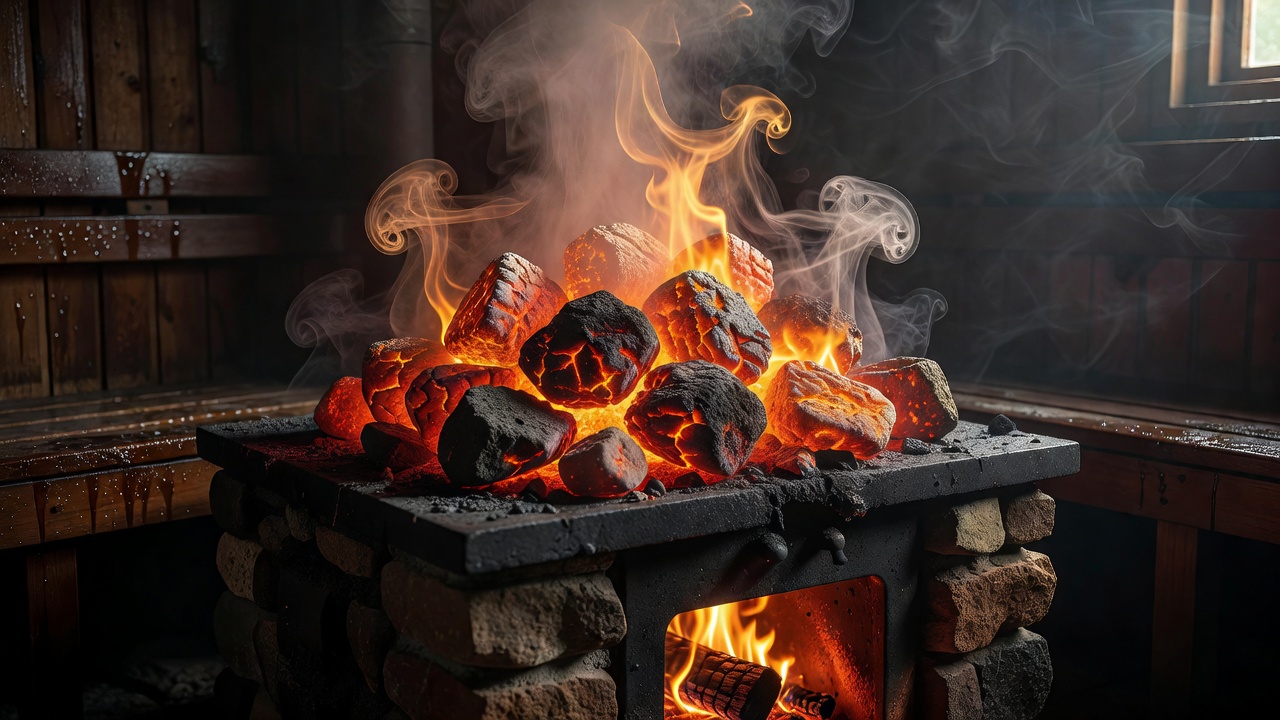
The Physics of 'Soft Löyly' vs. 'Scorching Steam'
When cold or lukewarm water hits superheated stone (300°C–450°C), instantaneous flash boiling occurs. If the stone matrix cools too rapidly or has high surface porosity, large water droplets bounce off without vaporizing, creating a coarse, prickling steam that burns the skin.
Conversely, high-density rocks with superior volumetric heat capacity atomize water into microscopic aerosol clouds (sub-micron droplet diameters) that gently warm the respiratory tract without searing the lungs.
Soapstone (Talcomagnesite) Analysis
Karelian soapstone contains approximately 40–50% talc and 40–50% magnesite. It possesses a specific heat capacity of 0.98 kJ/kg·K and a thermal conductivity of 6.4 W/m·K. Because it conducts heat twice as fast as granite, it rapidly absorbs energy from the firebox and radiates gentle far-infrared (FIR) wavelengths across the entire sauna cabin.
Olivine Peridotite Analysis
Peridotite is an ultramafic igneous rock composed almost entirely of olivine and pyroxene minerals. With a density of ~3.3 g/cm³, it exhibits nearly zero thermal expansion coefficient, meaning it can withstand thousands of cycles of violent cold water dousing without crumbling into stone dust or releasing toxic silica particles.
"Never use river stones or quartz-heavy sandstone in a closed firebox; trapped moisture inside crystalline micro-cavities causes explosive fracturing under thermal shock."
Summary Recommendation for Guild Builders
- Bottom Stove Layer: Large olivine peridotite boulders (10–15 cm) directly on the cast-iron grates to handle direct flame contact.
- Middle Thermal Mass: Medium-sized vulcanite or diabase stones to distribute heat upwards.
- Top Vapor Crown: Soapstone blocks or rounded ceramic spheres for silky, soft steam release.